Today, we’d like to take a look at the changes to the trading system. After repeatedly trying to tweak the old trade system over the past few years to achieve better results, it became clear to us this year: it doesn’t make sense this way—we need to rebuild the trade AI from the ground up. A major problem with the old trade AI was that most of the areas that generated trades (i.e., AI-to-AI trades, AI trades with human players, Draft Day trades, Emergency trades, etc.) used their own separate systems. This had three major drawbacks in particular:
- It often felt inconsistent to the user. Their own trade negotiations with AI teams were evaluated differently than trades between two AI teams or when a team traded a player via an emergency trade.
- The same system was used for all leagues.
- Technically, it was much harder for us to improve the trade AI because we had to make different changes in different places.
For the new Trade AI, we’ve written a single system this time that’s used identically by all systems. This feels much better for the user and ultimately leads to greater immersion. In addition, different leagues are now handled specifically by the same underlying system. In practice, this means the NHL’s Trade AI is no longer simply used for the Major Junior Leagues as well, but now models them individually. As a result, the value of draft picks or 20-year-old “veterans” is now taken into account much more sensibly here than in the old system.
Another major advantage is that it makes it much easier for us to improve the trade AI based on our own tests and user feedback. Because let’s be honest: trade AI is a very complex topic and will probably never satisfy everyone. That’s why it was all the more important for us to design the new system in a way that allows us to continuously improve and expand it.
If you look at the reactions to real-life trades in the media and on fan forums—where no one is ever really satisfied (as a Blackhawks fan, my first thought when the Bowen-Byram trade happened was, “What terrible AI!”)—then we naturally expect to see criticism of the trades in FHM 13 as well. But our new system finally allows us to collect and analyze this feedback and then respond quickly with improvements—and that was one of our top priorities (I wish, in reality, an update were enough to make the Chicago Trades better 🙂 ).
Negotiations with AI Teams
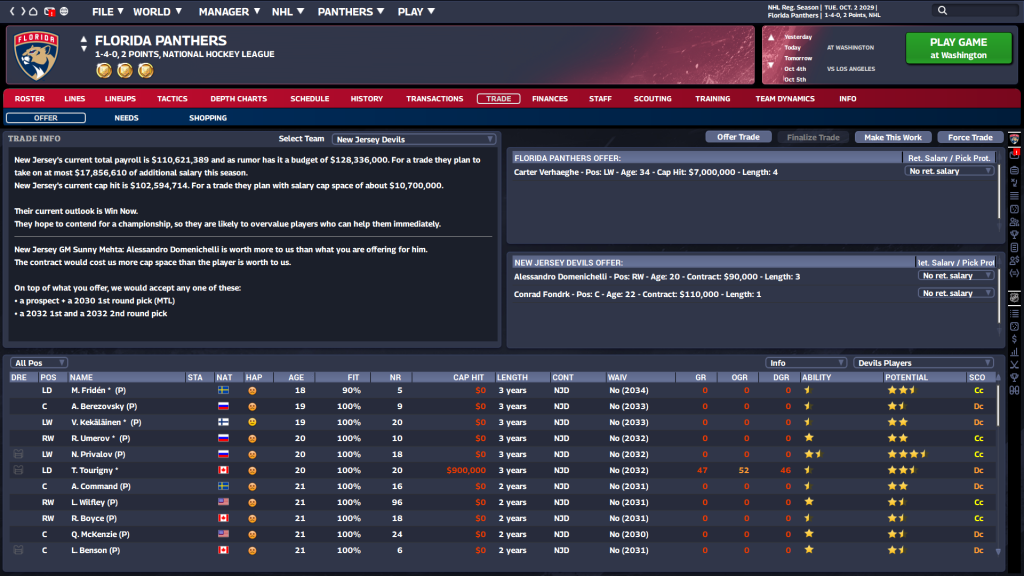
Another major change with the new system can be seen in trade negotiations with AI teams. These negotiations are now much more detailed. The other side now clearly explains why offers won’t work, what they’re asking for, or why, for example, the players offered aren’t a good fit. This makes it easier for users to negotiate trades with AI teams and, on top of that, enhances the immersion of a real negotiation.
To get additional informations on Franchise Hockey Manager and to wishlist the game on Steam visit:
If you want to comment on this blog post, please visit: